

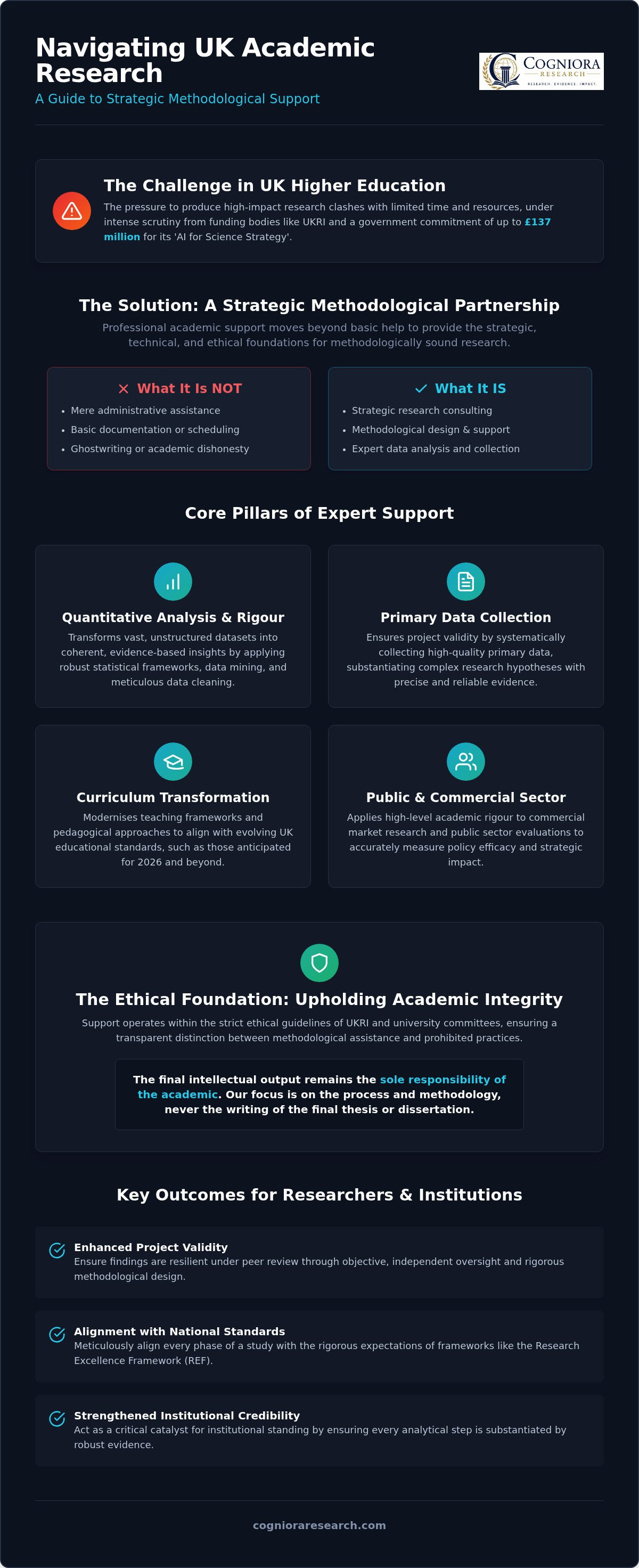
With the UK government allocating up to £137 million towards the 'AI for Science Strategy' through 2030, the benchmark for methodological precision within higher education has reached an unprecedented level of scrutiny. You likely understand that the pressure to produce valid, high-impact outputs often clashes with the reality of limited time for complex quantitative analysis and the logistical difficulty of securing high-quality primary data. It's a challenging environment where traditional educational frameworks frequently struggle to keep pace with rapid technological advancements and the evolving funding requirements of bodies like UKRI.
Engaging professional academic research support UK offers a strategic solution to these systemic pressures, ensuring your projects maintain the highest standards of intellectual integrity and analytical depth. This guide demonstrates how expert intervention in data mining, primary data collection, and curriculum transformation training enhances project validity, data precision, and institutional growth. You'll discover a clear path toward methodologically sound research outputs, modernised teaching frameworks, and the robust, evidence-based decision making required to thrive in the current UK research landscape.
Key Takeaways
- Understand how professional academic research support UK functions as a strategic methodological partnership rather than mere administrative assistance to ensure project validity.
- Discover how advanced quantitative data analysis and systematic primary data collection techniques substantiate complex research hypotheses and drive evidence-based results.
- Learn to apply high-level academic rigour to commercial market research and public sector evaluations to measure policy efficacy and strategic impact accurately.
- Explore the necessity of curriculum transformation training to modernise teaching frameworks in alignment with 2026 UK educational standards and pedagogical trends.
- Identify the criteria for selecting an independent research consultancy that offers the scholarly authority and technical expertise required for sophisticated institutional growth.
Defining the Landscape of Academic Research Support in the UK
The evolution of higher education has necessitated a shift in how institutions approach complex inquiries. Specialist academic research support UK is no longer a luxury but a fundamental methodological partnership. This collaboration moves beyond simple administrative assistance to provide strategic research consulting that defines the very architecture of a project. Whilst administrative help deals with scheduling or basic documentation, strategic consulting involves the design of analytical frameworks and the selection of rigorous data collection methods.
External expertise provides a vital layer of objectivity. It's often difficult for internal teams to identify their own cognitive biases or methodological blind spots. By involving an independent partner, researchers ensure that their findings are resilient under peer review. This relationship is strictly defined by an ethical boundary: support is provided for the process and methodology, whilst the final intellectual output remains the sole responsibility of the academic. Professional services never include the writing of the final thesis or dissertation; instead, they focus on the technical foundations that make such writing authoritative.
The Strategic Value of Methodological Consulting
Large-scale projects require a level of validity that can only be achieved through meticulous planning. Methodological consulting ensures that every phase of a study aligns with the rigorous expectations of the Research Excellence Framework (REF). This alignment is essential for institutions seeking to maintain or improve their standing in national assessments. Research support acts as a critical catalyst for institutional credibility by ensuring every analytical step is substantiated by rigorous evidence. It provides the technical scaffolding necessary to transform raw information into impactful, high-level insights that meet UK Higher Education standards.
Ethical Frameworks and Academic Integrity
Integrity is the cornerstone of all scholarly activity. Professional support services operate within the strict ethical guidelines established by UKRI and individual university ethics committees. This involves maintaining a transparent distinction between methodological assistance and the prohibited practice of ghostwriting. By focusing on data mining, primary data collection, and quantitative analysis, consultants help researchers navigate the complexities of their data without compromising their academic autonomy. Independent oversight during the data processing phase further reinforces the reliability of the research, ensuring it stands up to the most demanding peer-review processes.
Methodological Rigour: Quantitative Analysis and Primary Data Collection
Methodological precision acts as the definitive boundary between observational conjecture and substantiated theory. Within the framework of academic research support UK, the application of robust quantitative analysis ensures that hypotheses are tested against objective statistical benchmarks. This process involves more than simple calculation; it requires a systematic approach to data mining and secondary research synthesis to identify trends that are often invisible to the naked eye. By converting vast, unstructured datasets into coherent evidence-based insights, researchers can present a narrative that is both analytically sound and institutionally impactful.
Quantitative Analysis for Complex Datasets
The integrity of a study relies heavily on the quality of its underlying data. Statistical frameworks provide the necessary rigour to ensure that results are not merely coincidental but empirically valid. A critical component of this phase is data cleaning and validation, a meticulous process that removes outliers and corrects inconsistencies that could otherwise skew the final results. These high-level analytical techniques are equally valuable beyond the university setting, offering commercial and public sector organisations the clarity needed for strategic planning. Professionals seeking to refine their empirical approach often benefit from expert quantitative data analysis to ensure their findings withstand intense scrutiny.
Primary Data Collection Methodologies
Gathering high-quality primary data requires a sophisticated understanding of field management and survey design. For national-scale studies, the design of survey instruments must be exceptionally robust to avoid leading questions and response bias. Managing participant engagement whilst adhering to strict UK data protection standards is a complex logistical challenge that requires precise execution. Ensuring representative sampling across the diverse UK landscape is vital for the generalisability of the findings. This level of methodological detail is often a prerequisite for securing The British Academy funding or other major research grants. By implementing structured collection strategies, researchers can secure the high-quality data necessary to drive policy changes and academic discourse.
Bridging the Gap: Supporting Public Sector and Commercial Research
The application of high-level methodology isn't confined to the university. By extending the principles of academic research support UK into the commercial and public spheres, organisations can secure a level of analytical depth that traditional consultancy often lacks. This transition involves the rigorous translation of complex findings into actionable intelligence for corporate and governmental audiences. Evidence-based research has become a prerequisite for strategic decision-making, particularly as the UK government intensifies its focus on high-growth technology through the UK Research and Innovation (UKRI) strategy for 2026-2031. The bridge between theoretical research and practical application ensures that institutional growth is grounded in empirical reality rather than anecdotal evidence.
Commercial Market Research and Competitive Intelligence
In a saturated market, a commercial advantage is rarely found in surface-level data. By employing academic methodologies, businesses can conduct sophisticated market trend analysis that uncovers the nuanced drivers of consumer behaviour. This approach utilises advanced data mining to move beyond "what" is happening to "why" it occurs. Such depth allows firms to identify untapped niches and forecast shifts with a degree of certainty that standard market research cannot provide. It's about turning raw datasets into substantiated growth opportunities that inform multi-million pound investments with precision and systematic care.
Public Sector Programme Evaluation
Governmental bodies face increasing pressure to demonstrate the social impact and policy efficacy of their initiatives. Developing robust evaluative frameworks is essential for measuring the success of government-funded programmes, especially under the current £2 billion AI investment planned through 2030. Rigorous data collection provides the necessary evidence for policy modernisation and reform, ensuring that public funds are allocated based on proven results rather than projected outcomes. This level of scrutiny maintains public trust and ensures that large-scale social projects achieve their intended goals whilst remaining accountable to taxpayers and regulatory bodies alike.
Ultimately, the synthesis of academic rigour with commercial and public sector goals creates a robust foundation for long-term success. It's a methodical process that prioritises intellectual integrity and systematic care. Whether evaluating the social impact of a new public health initiative or identifying the next major shift in consumer technology, the reliance on substantiated insights remains constant. This evidence-driven approach acts as a reliable guide in a complex environment, transforming raw information into utility for decision-makers at every level of leadership.
Curriculum Transformation: Modernising Educational Frameworks
The current landscape of Higher Education requires more than incremental updates to course content. Curriculum transformation has emerged as a strategic institutional necessity, ensuring that academic programmes remain relevant in a rapidly evolving global economy. By 2026, educational standards in the UK will place a heightened emphasis on the integration of advanced technologies and interdisciplinary skills. This shift demands that institutions utilise professional academic research support UK to conduct thorough audits of existing frameworks. It's no longer sufficient to rely on historical success; modernised curricula must be driven by current data and forward-looking projections that reflect the needs of a digital-first society.
Research acts as the primary engine for curriculum modernisation. It allows departments to identify gaps between current teaching and the state-of-the-art in their respective disciplines. By conducting systematic reviews of global pedagogical trends, UK institutions can maintain their competitive edge. This evidence-based approach removes the guesswork from educational development, replacing it with a disciplined framework for growth. Every departmental change should be rooted in a deep understanding of how information is transformed into utility for the modern student.
Teaching Framework Modernisation Strategies
Adapting curricula to meet the needs of changing student demographics and digital-first learning environments is a complex undertaking. Pedagogy must be substantiated by contemporary research to ensure that teaching methods actually facilitate the intended learning outcomes. Curriculum transformation is the bridge between research and student outcomes. By aligning instructional design with empirical evidence, departments can ensure that their graduates possess the specific competencies required by the 2026 job market. This process involves a meticulous review of modular structures and assessment methods to ensure they reflect the latest developments in specific fields of study.
Managing Change in Educational Development
Implementing widespread pedagogical modernisation often encounters institutional inertia or resistance from established faculty. Overcoming these challenges requires specialised training for departments undergoing comprehensive curriculum review. It's essential to provide educators with the tools and data necessary to understand the benefits of these shifts. Tracking the impact of these changes on institutional performance provides the evidence-based justification needed for continued investment. For universities seeking to lead in this area, curriculum transformation training offers a structured path toward achieving these strategic goals. This methodical approach ensures that every change is purposeful, measurable, and aligned with long-term institutional growth.
Establishing a Strategic Research Partnership in the UK
Successful research outcomes depend on the seamless integration of external expertise within existing institutional frameworks. When seeking academic research support UK, the first step involves a precise audit of your project's methodological requirements. This diagnostic phase ensures that the scope of support, whether it involves complex data mining or comprehensive curriculum training, is perfectly aligned with your strategic objectives. By defining these parameters early, you establish a foundation for a partnership that is both transparent and results-oriented. It's a methodical transition that allows internal teams to focus on their core intellectual duties whilst technical complexities are handled with systematic care.
Integrating external support shouldn't disrupt established workflows. Instead, it should act as a sophisticated extension of your current capabilities. This involves setting clear protocols for data sharing, analytical milestones, and the final delivery of substantiated insights. When the boundaries of the partnership are well-defined, the transformation of information into utility becomes a predictable and reliable process. This structured approach is particularly vital for large-scale projects that require the coordination of multiple stakeholders across different departments or sectors.
Selecting an Independent Research Consultancy
Evaluation of a potential partner must prioritise scholarly authority and technical reliability. A consultant who understands the nuances of the UK academic landscape, including the specific demands of UKRI and the British Academy, provides value that goes beyond mere data processing. You should seek a partner capable of demonstrating a clear synergy between advanced data analysis and strategic action. This ensures that the insights produced are not just statistically significant but are also ready for practical application within a university or corporate setting. Reliability is found in a partner's ability to provide evidence-based guidance that withstands the most rigorous peer-review processes.
Implementing Evidence-Driven Insights
The true measure of a research partnership is its ability to drive tangible institutional growth. This requires a commitment to maintaining long-term collaborations that foster continuous curriculum evolution and sustained analytical excellence. Evidence-driven insights must be woven into the fabric of departmental decision-making to ensure they remain relevant as pedagogical standards shift. By establishing a rhythm of regular review and update, institutions can remain at the forefront of their respective fields. For organisations and academic departments ready to enhance their methodological rigour, it's essential to enquire about strategic research support with Cogniora to begin the journey toward substantiated and impactful results.
Advancing Institutional Intelligence through Methodological Excellence
The pursuit of intellectual integrity requires a disciplined approach to every stage of the research lifecycle. By prioritising methodological rigour, institutions ensure that their outputs remain resilient under the highest levels of scrutiny. We've explored how the integration of advanced quantitative analysis and systematic primary data collection transforms raw information into a vital asset for strategic growth. This evolution extends beyond the university, providing the evidence-based clarity necessary for public sector evaluation and commercial market intelligence.
Securing professional academic research support UK allows your organisation to navigate these complexities with composed confidence. It's a partnership that bridges the gap between theoretical inquiry and tangible utility. Through specialised quantitative analysis expertise and a methodical approach to primary data collection, projects achieve a level of precision that drives meaningful reform and institutional modernisation. Use these frameworks to ensure your research remains a reliable guide in an increasingly complex environment.
If you're ready to enhance the validity and impact of your work, you can partner with Cogniora Research for expert methodological support. Utilising evidence-based curriculum transformation frameworks and rigorous analytical standards will position your institution as a leader in a data-driven landscape. We look forward to supporting your journey toward scholarly authority and informed action.
Frequently Asked Questions
What is the difference between academic research support and dissertation writing?
Professional academic research support UK focuses on methodological rigour, technical data analysis, and strategic framework design. It's distinct from dissertation or thesis writing, which are services Cogniora Research Limited strictly excludes. Whilst support facilitates the analytical process, the final intellectual output remains the researcher's responsibility. This distinction ensures academic integrity whilst providing the technical scaffolding required for high-impact results and substantiated findings.
How does quantitative data analysis improve the quality of a research project?
Quantitative data analysis substantiates research hypotheses by applying rigorous statistical frameworks to raw datasets. It removes subjective bias and identifies patterns that aren't visible through qualitative observation alone. By utilising precise cleaning and validation processes, researchers ensure their findings are empirically sound. This level of precision is vital for projects intended for peer-reviewed journals or institutional policy decisions that require high-level analytical depth.
Can commercial organisations benefit from academic research methodologies?
Commercial entities gain a significant advantage by applying academic methodologies to market research challenges. This approach provides a deeper understanding of consumer behaviour and market trends than traditional business consulting. By using substantiated insights, firms can identify growth opportunities with greater certainty. It transforms raw information into a strategic tool for informed decision-making, ensuring that corporate investments are grounded in empirical reality.
What does curriculum transformation training involve for UK universities?
Curriculum transformation training involves a comprehensive review of existing teaching frameworks to align them with modern pedagogical standards. This process includes implementing evidence-based changes across departments to improve student outcomes. Training focuses on managing institutional change and ensuring that new curricula are substantiated by current research. It's a strategic necessity for institutions seeking to remain competitive and relevant in the 2026 educational landscape.
How is primary data collection managed to ensure ethical compliance?
Primary data collection is managed through robust survey design and strict adherence to UK data protection regulations. Ethical compliance is maintained by ensuring transparent participant engagement and secure data handling protocols. Each collection strategy is designed to produce a representative sample whilst protecting individual privacy. This methodical approach ensures that the gathered data is both high-quality and legally compliant for scholarly and commercial use.
Why is evidence-based research essential for public sector programme evaluation?
Evidence-based research is the only reliable way to measure the impact and policy efficacy of government-funded initiatives. It provides the objective data necessary for public sector modernisation and reform. Without rigorous evaluation, it's impossible to determine if public funds are achieving their intended social goals. This level of scrutiny ensures accountability and helps governmental bodies refine their programmes based on proven results rather than projections.
How can data mining support secondary research in a commercial context?
Data mining allows commercial organisations to synthesise vast amounts of secondary research into actionable competitive intelligence. It identifies long-term market trends and shifts in consumer sentiment that might otherwise be overlooked. By extracting utility from existing datasets, businesses can forecast future demands with increased accuracy. This methodical synthesis of secondary information provides a cost-effective foundation for strategic planning and robust risk mitigation in complex markets.
What are the benefits of outsourcing research support to a UK-based consultancy?
Outsourcing to a UK-based consultancy provides access to specialised expertise that understands the national research landscape. Partners like Cogniora Research Limited offer objectivity and technical depth that might be unavailable internally. A local consultancy is well-versed in the requirements of UKRI and other national funding bodies. This partnership ensures your project maintains the highest standards of methodological rigour, technical precision, and institutional credibility.