

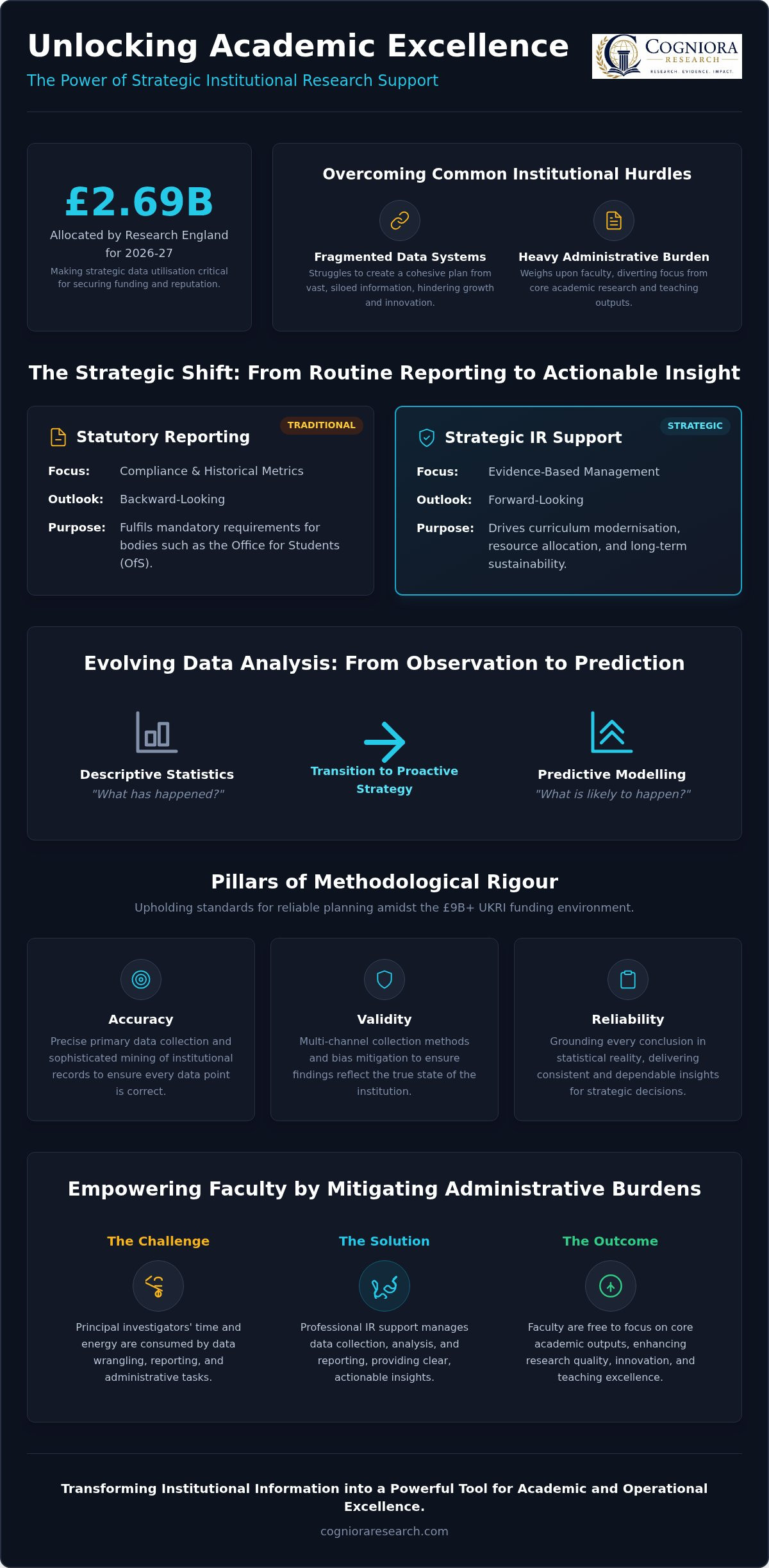
With Research England allocating a total of £2,689 million for the 2026-2027 academic year, the financial, reputational, and strategic stakes for higher education providers are exceptionally high. However, the capacity to secure and manage these funds is often hindered by fragmented data systems and a heavy administrative burden that weighs upon faculty. It's an established reality that many institutions struggle to translate vast amounts of raw information into a cohesive plan for growth and innovation. Implementing professional institutional research support UK frameworks offers a systematic solution to these challenges, ensuring that academic rigour remains the central focus of the university's mission.
This article demonstrates how expert support enhances faculty output, strengthens strategic decision-making, and facilitates successful curriculum modernisation. By moving beyond inconsistent departmental analysis toward a unified model of quantitative data mining and primary collection, leaders can act with composed confidence. We'll examine the specific methodologies that enable institutions to manage the complex funding landscape of 2026, transforming institutional information into a powerful tool for academic and operational excellence.
Key Takeaways
- Understand the critical distinction between routine statutory reporting and the strategic implementation of data-driven insights to inform institutional policy.
- Recognise the importance of methodological rigour and advanced quantitative analysis in producing statistically significant findings for reliable strategic planning.
- Learn how professional institutional research support UK services mitigate the administrative burden on faculty, allowing principal investigators to focus on core academic outputs.
- Transition from basic descriptive statistics to sophisticated predictive modelling to accurately forecast institutional performance and optimise resource distribution.
- Discover how specialised curriculum transformation training can modernise academic frameworks whilst ensuring adherence to rigorous ethical and quality standards.
Defining Institutional Research Support within the UK Landscape
Institutional research (IR) serves as the intellectual engine of higher education, defined by the systematic collection and analysis of data to underpin institutional planning and policy formation. Within the UK research funding system, the role of IR has transitioned from a purely administrative function to a sophisticated, consultative model. It's no longer sufficient to merely observe trends; institutions must now actively interpret them to maintain competitive standing. This evolution reflects a broader movement toward evidence-based management where every strategic decision is substantiated by rigorous analytical frameworks.
A critical distinction exists between statutory reporting and strategic institutional research support UK. Statutory reporting fulfils mandatory requirements for bodies such as the Office for Students (OfS), focusing on compliance and historical performance metrics. In contrast, strategic IR support is forward-looking. It provides the evidence base required for curriculum modernisation, resource allocation, and long-term sustainability. This strategic approach rests on three core pillars: identifying complex information needs, executing precise data collection, and delivering evaluative reporting that drives institutional change.
The Functional Areas of Institutional Research
The efficacy of IR depends on its ability to identify the diverse information needs amongst faculty and senior management. This involves establishing robust frameworks for data stewardship and information consumption, ensuring that data is not only accurate but also accessible for those who require it. Effective IR bridges the gap between raw datasets and strategic decision-making by transforming abstract numbers into actionable insights. This process requires a deep understanding of both quantitative methodology and the specific nuances of the UK higher education sector, ensuring that insights are relevant to the unique challenges of the academic environment.
The Strategic Value of Independent Partnerships
Engaging independent partners for institutional research support UK provides a level of objectivity that internal departments may struggle to maintain. External expertise offers an unbiased lens through which to evaluate departmental performance and faculty output whilst upholding the highest standards of methodological rigour. These partnerships are particularly valuable when navigating the Strategic Institutional Research Funding (SIRF) landscape. With Research England undertaking a comprehensive review of SIRF until 2030, having a reliable, evidence-driven guide is essential for institutions aiming to align with evolving government priorities for economic growth and innovation. Professional partners act as a bridge between complex data environments and the informed actions necessary for long-term institutional stability.
Methodological Rigour: Accuracy, Validity, and Reliability
Maintaining methodological integrity is paramount for institutions operating within the framework of UK Research and Innovation (UKRI). With a total budget exceeding £9 billion for the 2026-2027 financial year, the accountability for results has never been more stringent. Professional institutional research support UK ensures that every data point is collected with precision and every conclusion is grounded in statistical reality. This requires a dual focus on both primary data collection and the sophisticated mining of existing institutional records to provide a holistic view of performance.
Primary Data Collection and Stakeholder Engagement
Designing instruments that capture authentic institutional behaviour is a complex task. It's not enough to simply distribute a survey; the methodology must account for sampling bias and participant fatigue. Effective engagement strategies utilise multi-channel collection methods to ensure high response rates amongst diverse faculty groups. This rigour protects the validity of the findings, ensuring they reflect the true state of the institution rather than a skewed subset of data. Managing these processes with systematic care allows for the capture of nuanced qualitative insights alongside quantitative metrics.
Quantitative analysis must meet high standards for statistical significance to be useful for strategic planning. This involves rigorous testing for reliability and validity, ensuring that findings aren't merely coincidental. In the UK, this process is intrinsically linked to ethical compliance and data protection. Adhering to the Data Protection Act 2018 and UK GDPR is a non-negotiable requirement for any credible research initiative. Institutions that prioritise these standards build trust with their stakeholders and secure their reputations within the global academic community. It's often beneficial to engage in academic research support to ensure these complex ethical and analytical standards are met without compromise.
Secondary Data Mining and Evidence Synthesis
Many universities possess vast legacy datasets that remain underutilised. Secondary data mining allows for the extraction of long-term trends that can inform future growth and resource allocation. By synthesising evidence from diverse sources, institutions can support comprehensive programme evaluations and faculty output assessments. This transformation of raw data into actionable intelligence allows faculty leads to make informed decisions without the burden of manual data processing. Using existing institutional knowledge in this way provides a cost-effective method for identifying areas of excellence and opportunities for curriculum modernisation.
Quantitative Data Analysis: Interpreting Complex Institutional Datasets
The analytical landscape of higher education is evolving. Advanced statistical analysis is no longer viewed as a peripheral technical function but as a core requirement for institutional survival. Under UKRI's government mandate, universities are increasingly held accountable for the tangible outcomes of their research and teaching activities. Utilising professional institutional research support UK allows institutions to transition from basic descriptive statistics to sophisticated predictive modelling. Whilst descriptive data provides a retrospective view of what has occurred, predictive modelling utilises historical patterns to forecast future trends. This shift enables strategic planning that is proactive rather than reactive, providing a substantiated foundation for long-term growth.
Statistical Analysis for Programme Evaluation
Measuring the impact of specific institutional initiatives requires a level of rigour that standard administrative reporting often lacks. Through the application of rigorous quantitative methods, such as multivariate analysis and regression modelling, researchers can determine the true efficacy of new programmes or faculty support structures. Longitudinal studies are particularly vital in this context. They allow for the tracking of student and faculty cohorts over extended periods, revealing the subtle factors that influence progression and output. This depth of analysis ensures that findings are statistically significant and robust enough to withstand the pressure of external audits or peer-reviewed publication. It's a process of verification that transforms anecdotal evidence into empirical certainty.
Interpretation and Strategic Reporting
Data only gains utility when it's interpreted through a strategic lens. Raw datasets, regardless of their size, remain inert without context-rich interpretative reports. These reports must align analytical outputs with specific institutional KPIs and national benchmarks to ensure relevance. Visualisation plays a pivotal role here. By translating complex statistical relationships into clear, rhythmic, and structured visual formats, researchers make sophisticated insights accessible to non-technical stakeholders. This clarity is essential for executive decision-making. It ensures that senior management can identify risks, opportunities, and trends with composed confidence. It doesn't matter how vast the data is if it can't be understood by those who hold the authority to act upon it. The ultimate goal is to create a seamless flow of information from the point of collection to the boardroom, ensuring that every strategic move is backed by solid evidence.
Enhancing Faculty Output whilst Reducing Administrative Burdens
The primary constraint on academic excellence is frequently not a lack of intellectual ambition but the overwhelming administrative burden placed upon faculty. Principal Investigators (PIs) are often forced to balance high-level conceptual work with the minutiae of data management, survey logistics, and routine statistical processing. Professional institutional research support UK offers a systematic solution by decoupling these operational tasks from core academic enquiry. This strategic separation ensures that the institution's most valuable assets, its researchers, can dedicate their cognitive energy to discovery rather than data entry.
Operational Efficiency for Principal Investigators
Identifying and organising repetitive analytical tasks is the first step toward reclaiming faculty time. Many PIs find that a significant portion of their week is consumed by cleaning legacy datasets or managing basic quantitative analysis workflows. By outsourcing these functions to a dedicated partner, institutions can significantly accelerate publication timelines. This approach reduces the friction between initial data gathering and the generation of final insights, allowing for a more rhythmic and predictable research output. When researchers aren't bogged down by the mechanics of data mining, the quality and volume of their scholarly contributions naturally increase. Efficiency is the foundation of growth.
Professional Management of Field Research
National-scale studies present unique logistical complexities that can easily overwhelm a departmental team. Professional management of primary data collection ensures consistency across multiple institutional centres, which is essential for maintaining methodological rigour. Specialised field research management handles participant recruitment, multi-channel data gathering, and ethical compliance monitoring. This level of oversight provides a degree of reliability that is difficult to achieve through ad-hoc faculty-led efforts. Freeing faculty from these logistical burdens allows them to focus on the high-level interpretation of results and the modernisation of curricula. Consistency remains vital for credibility.
A structured support model does more than just save time; it fosters a more productive research culture where excellence is expected and enabled. Institutions that invest in external partnerships demonstrate a commitment to faculty well-being and intellectual integrity. This investment transforms the academic environment from one of constant crisis management to one of disciplined, evidence-driven growth. By utilising professional institutional research support UK, leaders can ensure their staff are supported by robust analytical frameworks. To learn more about how specialised frameworks can assist your institution, explore our academic research support services. Ultimately, the goal is to create a seamless interface between raw institutional data and the strategic actions that drive academic prestige.
Cogniora Research: Your Partner in Academic and Curriculum Transformation
Cogniora Research Limited operates as a specialist consultancy dedicated to the advancement of academic and public sector research excellence. We position ourselves as a strategic partner for institutional leaders and principal investigators. Our approach integrates professional institutional research support UK with specialised training to ensure that data doesn't remain siloed within administrative departments. Instead, we facilitate the transformation of raw information into utility, driving growth and intellectual integrity through substantiated insights. Every project we undertake is grounded in a commitment to precision and systematic care.
Curriculum Transformation and Pedagogical Modernisation
Modernising teaching frameworks requires more than anecdotal feedback; it demands a foundation of rigorous evidence. Institutional research informs this process by identifying gaps in current pedagogical structures and highlighting areas where student engagement or outcomes can be improved. We assist institutions in navigating the complexities of curriculum change management through structured training programmes. These initiatives empower faculty to implement evidence-based changes that align with both institutional goals and evolving national standards. By bridging the gap between analytical findings and classroom practice, we ensure that curriculum transformation is both methodical and impactful.
A Consultative Approach to National Research Standards
Aligning institutional objectives with the wider UK research landscape is essential for maintaining competitive standing and securing funding. Our consultative model ensures that data collection and quantitative analysis meet the highest standards of validity and reliability. We act as a reliable guide, helping institutions navigate the journey from information gathering to real-world results. This commitment to methodological rigour is matched by our adherence to strict ethical boundaries. Cogniora Research Limited doesn't provide dissertation or thesis writing services. This exclusion is a deliberate choice to maintain professional integrity and ensure that our support remains focused on institutional and faculty-level excellence.
Our internal processes are designed to be as organised and reliable as the insights we produce for our clients. Whether we're conducting secondary data mining or managing primary data collection, the focus remains on delivering precise, high-level analysis that supports strategic decision-making. We invite institutional leaders to enquire about our strategic research and curriculum support to discover how an independent partnership can enhance academic rigour and faculty output. Transitioning between raw data and informed action requires an expert voice that values thoroughness and intellectual integrity.
Advancing Institutional Excellence through Evidence-Driven Action
The transition from fragmented data to unified strategic excellence requires a disciplined approach to information architecture. Professional institutional research support UK frameworks allow universities to move beyond basic statutory reporting toward a model of predictive intelligence. By outsourcing complex quantitative analysis and primary data collection, institutions don't just save time; they protect the intellectual capacity of their faculty. This systematic reduction of administrative friction is essential for maintaining a competitive edge in the current funding landscape.
Success in the modern higher education sector depends on the ability to modernise curricula whilst upholding the highest ethical standards. Cogniora Research Limited acts as a strategic partner in this journey. We are specialists in quantitative data analysis and provide expert curriculum transformation training, all whilst adhering to strictly professional and ethical research standards. We invite you to partner with Cogniora Research for rigorous institutional support and take a decisive step toward evidence-based growth. Your institution's potential is best realised when supported by methodical thinking and authoritative insights.
Frequently Asked Questions
What is the scope of institutional research support in the UK?
The scope of institutional research support in the UK encompasses the systematic collection, analysis, and interpretation of data to inform institutional planning and policy formation. It extends beyond routine statutory reporting to include strategic activities such as curriculum modernisation, student progression tracking, and resource allocation. Professional support provides the analytical frameworks necessary to transform fragmented departmental data into a unified evidence base that substantiates long-term strategic decisions and enhances institutional reputation.
How does external data analysis support improve faculty research output?
External data analysis support improves faculty output by alleviating the administrative and technical burdens that often weigh upon principal investigators. By outsourcing repetitive analytical tasks and data cleaning, researchers can dedicate their cognitive energy to high-level conceptual work and discovery. This strategic separation of duties accelerates publication timelines and ensures that results are grounded in rigorous statistical methodology, allowing faculty to focus on their core academic mission without operational distractions.
Can institutional research help with curriculum transformation?
Institutional research serves as a critical catalyst for curriculum transformation by providing the empirical evidence required for pedagogical modernisation. It identifies specific gaps in teaching frameworks and highlights areas where student engagement or outcomes require intervention. Through structured training and data-driven insights, institutions can implement effective changes that align with both internal academic goals and evolving national benchmarks, ensuring that teaching remains relevant and rigorous.
What is the difference between primary data collection and secondary data mining?
Primary data collection involves the gathering of new, original information through instruments such as surveys, interviews, or observations designed for a specific research objective. In contrast, secondary data mining focuses on the extraction and synthesis of value from existing legacy datasets or external records. Both methods are essential for a comprehensive institutional research support UK strategy, providing a holistic view of current performance whilst identifying long-term historical trends.
Does Cogniora Research provide support for dissertation or thesis writing?
Cogniora Research Limited does not provide support for dissertation or thesis writing. This exclusion is a deliberate policy designed to maintain the highest levels of professional and ethical integrity within the academic sector. Our services are strictly focused on institutional-level support, faculty output enhancement, and strategic consultancy for academic, commercial, and public sector organisations. We prioritise the delivery of substantiated insights that support organisational excellence rather than individual student assignments.
How is data security managed during institutional research projects?
Data security is managed through rigorous adherence to the Data Protection Act 2018 and UK GDPR standards. Every project involves systematic protocols for data stewardship, ensuring that sensitive institutional information is handled with precision and confidentiality. By implementing robust encryption and access controls, professional research partners protect the integrity of the data whilst maintaining the trust of all stakeholders involved in the collection and analysis process.
What role does quantitative analysis play in programme evaluation?
Quantitative analysis plays a pivotal role in programme evaluation by providing statistically significant measurements of impact. Through the application of multivariate analysis and longitudinal tracking, institutions can determine the true efficacy of specific initiatives or pedagogical changes. This level of rigour ensures that evaluations are robust enough to withstand external audits or peer reviews, transforming anecdotal feedback into an empirical foundation for future programme development and resource allocation.
How can independent consultancies help with SIRF funding reviews?
Independent consultancies assist institutions in navigating the Strategic Institutional Research Funding (SIRF) landscape by providing an objective lens for performance evaluation. With Research England undertaking a comprehensive review of SIRF until 2030, expert partners help align institutional goals with evolving government priorities for economic growth. This consultative approach ensures that data is presented with the clarity and rigour required to secure and maintain formula-driven funding in a complex environment.
