

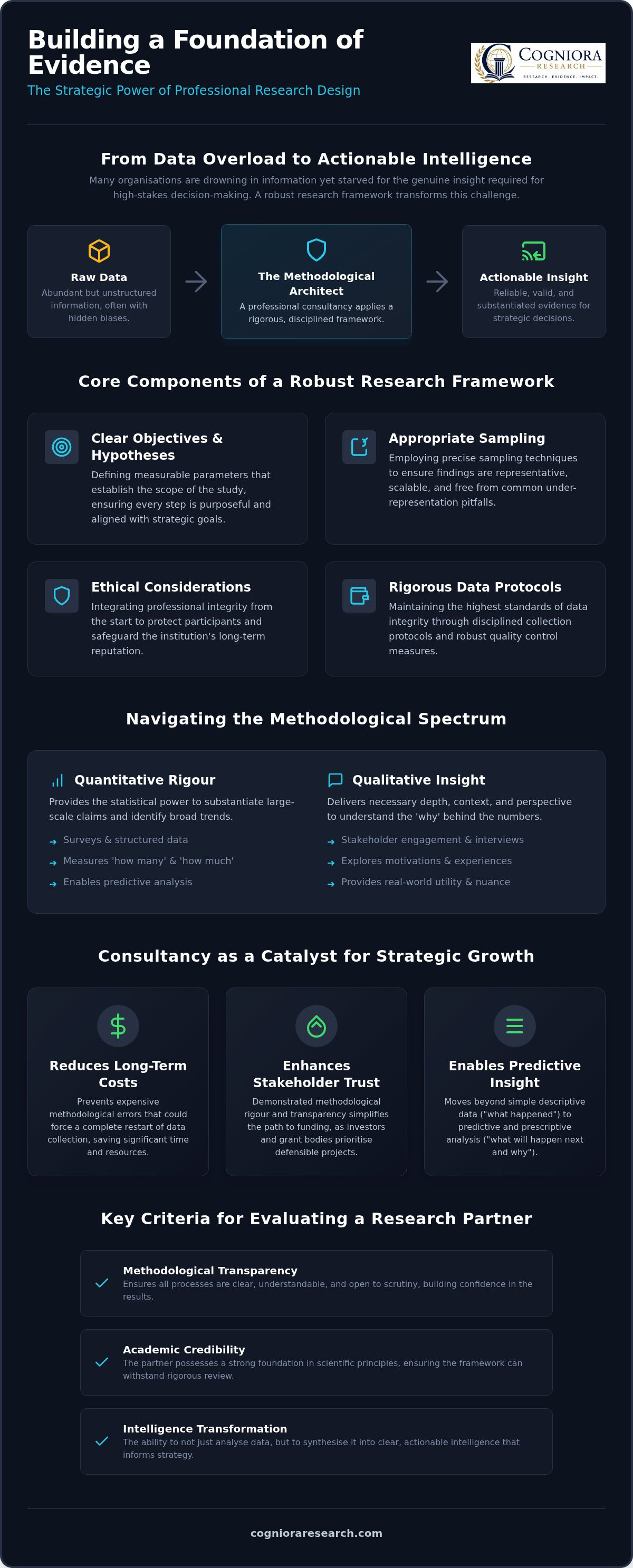
A flawed methodological foundation is the silent architect of institutional failure. Whilst raw data is abundant, the capacity to structure it into a reliable, valid, and substantiated evidence base remains a specialised skill. You likely recognise the frustration of managing inefficient collection processes or the persistent anxiety that internal biases might invalidate your primary data. It's a common challenge for leaders to find themselves drowning in information yet starved for the genuine insight required for high-stakes decision-making.
Engaging a professional research design consultancy UK ensures that your projects are built upon a robust and disciplined framework. This guide explores how expert consultancy transforms complex datasets into actionable strategic intelligence while maintaining the highest standards of methodological rigour. We'll examine the specific mechanisms used to modernise institutional research, eliminate analytical risks, and bridge the critical gap between information gathering and tangible results.
Key Takeaways
- Understand how a research design consultancy UK serves as a methodological architect to ensure that every stage of investigation is robust, valid, and aligned with strategic objectives.
- Learn to distinguish between primary data collection and secondary data mining to build a multi-layered evidence base that provides both historical context and real-world utility.
- Recognise the critical importance of quantitative data analysis in substantiating large-scale claims whilst using qualitative insights to provide necessary depth and perspective.
- Identify the core criteria for evaluating a research partner, prioritising methodological transparency, academic credibility, and the ability to transform complex data into actionable intelligence.
- Discover how specialised curriculum transformation training can modernise institutional frameworks by integrating evidence-based insights into educational strategy.
The Strategic Importance of Research Design Consultancy in the UK
Research design serves as the architectural blueprint for any empirical investigation. It's the foundational structure that dictates how data is gathered, measured, and analysed to answer specific questions. Within the professional landscape, it's vital to distinguish between creative design and a methodological research design consultancy UK. Whilst the former focuses on aesthetic communication, the latter is a rigorous scientific discipline concerned with the integrity of evidence. For a comprehensive overview of research design, one must look at the totality of the investigative process, from the initial conceptualisation to the final synthesis of results.
UK institutions often require independent oversight to ensure that data interpretation remains objective and substantiated. Without this external scrutiny, internal projects risk falling prey to systemic research bias, where existing institutional assumptions inadvertently colour the findings. A professional consultancy acts as a safeguard, ensuring that the validity of the outcomes isn't compromised by narrow perspectives or flawed logic. This methodical approach is what transforms a collection of raw observations into a defensible body of knowledge that can withstand the rigours of peer review or commercial auditing.
The Core Components of a Robust Research Framework
A disciplined framework begins with the establishment of clear research objectives and measurable hypotheses. These aren't merely goals; they're the parameters that define the scope of the entire study. For national studies conducted across the UK, selecting appropriate sampling techniques is a necessity to ensure that findings are representative and scalable. When a research design consultancy UK is involved, these technical choices are made with precision to avoid the common pitfalls of under-representation. Additionally, integrating ethical considerations into the initial design phase isn't just a regulatory requirement; it's a fundamental component of professional integrity that protects both the participants and the institution's long-term reputation.
Consultancy as a Catalyst for Strategic Growth
Professional design allows organisations to move beyond simple descriptive data. By employing advanced methodologies, a consultancy enables the shift toward predictive and prescriptive insights, telling leaders not just what happened, but what is likely to occur next. This foresight is a primary driver of strategic growth in complex markets. It also serves a practical financial purpose. Rigorous design reduces long-term costs by preventing expensive methodological errors that could necessitate a complete restart of the data collection process. Ultimately, the presence of a robust framework enhances stakeholder trust and simplifies the path to funding acquisition, as investors and grant bodies prioritise projects with demonstrated methodological rigour and transparency.
Methodological Frameworks: From Primary Data Collection to Evidence Synthesis
The transition from theoretical design to empirical execution requires a disciplined methodological framework. A professional research design consultancy UK ensures that every data point captured is both relevant and reliable. This process begins with a systematic approach to primary data collection, where the focus remains on maintaining the highest standards of data integrity through rigorous collection protocols and quality control. By establishing these guardrails early, institutions avoid the common pitfall of gathering vast quantities of information that lack the necessary depth for meaningful analysis.
Primary Data Collection Strategies
Effective primary research necessitates the design of survey instruments that minimise respondent fatigue and neutralise potential bias. It's a delicate balance; you need comprehensive data without overwhelming the participant. High-quality qualitative data often relies on deep stakeholder engagement, ensuring that the voices captured reflect the diversity of the target population. Adhering to inclusive social research practices is essential for modern UK studies, as it ensures that the evidence base is representative and ethically sound. Managing large-scale field research without losing data granularity requires a decentralised yet highly coordinated approach, where quality control is embedded at every stage of the journey.
Secondary Data Mining and Evidence Synthesis
Secondary data mining provides the historical context necessary for truly informed strategic planning. By extracting value from existing datasets, an organisation can identify long-term trends that primary research alone might overlook. This evidence synthesis involves a methodology of systematic reviews, common in both academic and commercial research, to evaluate the existing body of knowledge. The goal is to synthesise diverse data sources into a cohesive, authoritative narrative that serves as a single source of truth for decision-makers.
Evidence-based insights are particularly vital in the modernisation of public sector programmes. When policies are built on substantiated data rather than conjecture, the outcomes are more predictable and effective. For those seeking to refine their internal processes, partnering with a specialised consultancy helps bridge the gap between raw information and strategic action. This methodical synthesis transforms disparate facts into a powerful tool for institutional growth and public benefit, ensuring that every project contributes to a wider understanding of the subject matter. A research design consultancy UK provides the necessary oversight to ensure these synthesised narratives remain objective and academically rigorous.
Quantitative Rigour vs. Qualitative Insight: Navigating the Methodological Spectrum
Navigating the methodological spectrum requires more than a cursory understanding of data types. It demands a disciplined approach to evidence gathering that respects both the scale of numerical data and the depth of human experience. For any research design consultancy UK, the challenge lies in selecting the precise instrument for the task. Whilst quantitative methods provide the breadth needed for generalisability, qualitative insights offer the granular context that makes those numbers meaningful. A successful research output isn't a choice between these two, but rather a strategic integration of both to serve a specific institutional or commercial goal.
The Power of Quantitative Data Analysis Services
Quantitative data analysis serves as the engine for substantiating large-scale research claims. By utilising advanced statistical models, consultants can identify correlations that remain invisible to the naked eye. This process isn't solely about calculation; it relies heavily on meticulous data cleaning and validation to ensure that the resulting trends are genuine rather than artefacts of flawed collection. Quantitative rigour in UK consultancy is defined by the application of exacting mathematical standards to ensure that every statistical inference is derived from verified, error-free datasets. This level of precision is vital when conducting commercial market research, where a single percentage point can influence significant capital investment or operational shifts.
Qualitative Depth and Contextual Understanding
Numbers explain the "what", but qualitative data uncovers the "why". Capturing the nuances of participant behaviour or institutional culture requires a different set of analytical tools. In the context of curriculum transformation, for example, qualitative insights are indispensable. They allow educational leaders to understand the pedagogical challenges and cultural resistances that quantitative surveys might overlook. Through systematic thematic analysis, a consultancy can categorise complex stakeholder feedback into a coherent framework for change. This depth of understanding is what allows public sector research to move beyond surface-level observations and address the root causes of systemic issues.
The hybrid approach remains the gold standard for public policy evaluation and high-stakes commercial projects. Ensuring statistical significance is a non-negotiable requirement for any study used to justify public expenditure or new policy frameworks. However, without the qualitative context, these policies risk failing at the implementation stage. By partnering with a research design consultancy UK that understands this delicate balance, organisations can produce evidence that is both statistically robust and contextually grounded. This dual-layered evidence base provides the composed confidence required to lead institutional growth and navigate complex social landscapes with precision.
Key Criteria for Evaluating a Research Design Partner in the UK
Selecting a partner for empirical investigation requires a shift in perspective from mere service procurement to strategic alliance. A professional research design consultancy UK must be evaluated on its ability to bridge the gap between abstract theory and practical utility. This assessment begins with an examination of the consultancy’s track record across both academic and commercial sectors, as the cross-pollination of these environments often produces the most robust insights. Methodological transparency is a non-negotiable requirement. Partners must provide detailed reporting standards that allow for the replication and auditing of results, ensuring that every conclusion is substantiated by a clear, visible trail of evidence.
The ability to handle complex datasets whilst providing specialised training is a primary indicator of a consultancy's maturity. Organisations should look for partners who don't just deliver data but also empower internal teams through knowledge transfer. This ensures that the modernisation of research processes becomes a permanent institutional asset rather than a temporary external fix. The partner must also demonstrate a sophisticated understanding of the UK regulatory environment, specifically regarding data protection and ethical research guidelines, to protect the organisation from reputational or legal risk.
Professional Standards and Ethical Compliance
Independence is the cornerstone of objective research. To maintain intellectual integrity, a consultancy must remain entirely separate from the subject of the study. Reputable firms explicitly exclude services like dissertation or thesis writing, as these activities compromise the ethical boundaries of academic support. When evaluating lead consultants, verify their scholarly credentials and history of published work. This background ensures they possess the intellectual depth to handle high-stakes projects whilst adhering to the Data (Use and Access) Act 2025 and established ethical frameworks.
Technical Capability and Analytical Tools
The capacity to manage large-scale data mining and primary collection requires proficiency in modern statistical software and analytical frameworks. Beyond technical skill, the role of pedagogical expertise is vital for educational initiatives, where curriculum transformation training requires a deep understanding of learning structures. Scalability is equally important. A partner should demonstrate the infrastructure required for national-level research initiatives without sacrificing the granularity of the data. This technical sophistication ensures that the transformation of information into strategic intelligence is both seamless and reliable.
If your organisation requires a partner capable of delivering this level of methodological rigour, you can consult with our lead specialists to discuss your specific research objectives and framework requirements.
Cogniora Research: Advancing Institutional and Commercial Intelligence
The Cogniora Research Limited philosophy is built upon the conviction that information only gains value when it's transformed into utility. As a leading research design consultancy UK, we act as a bridge between the complexities of raw data and the requirements of informed action. This transition requires more than just technical proficiency; it demands a deep commitment to intellectual integrity and a methodical approach to investigative design. By maintaining a serious, evidence-based demeanour, we ensure that the insights we provide are both substantiated and actionable for our partners in the academic, commercial, and public sectors.
Curriculum Transformation and Pedagogical Modernisation
Educational institutions face the persistent challenge of aligning traditional structures with modern evidence. Cogniora Research Limited assists these organisations in implementing effective pedagogical changes through a systematic process of curriculum review and the implementation of modern frameworks. Unlike internal university initiatives, our independent consultancy provides an objective lens, allowing for the adoption of learning models that are grounded in rigorous research. We provide specialised training that empowers faculty to deliver evidence-based education, ensuring that the transformation is both sustainable and measurable. This methodical review process identifies gaps in existing structures and replaces them with robust, future-oriented pedagogical strategies.
Comprehensive Research and Data Analysis Solutions
Our approach to quantitative data analysis is defined by a refusal to compromise on methodological rigour. For both academic and commercial clients, we ensure that every project is grounded in objective truth. This involves the application of advanced analytical frameworks to large-scale datasets, ensuring that the results are statistically significant and free from the biases that often plague internal studies. As a specialised research design consultancy UK, we focus on the journey from information gathering to real-world results. We provide the composed confidence required to handle complex challenges with precision and systematic care.
By prioritising credibility over marketing flair, Cogniora Research Limited has established itself as a reliable guide in a complex data environment. We explicitly exclude services such as dissertation writing to reinforce our professional and ethical standards, focusing instead on high-level institutional and commercial intelligence. If your organisation requires a partner to modernise its research processes and deliver valid, evidence-based insights, you can enquire about our professional research design and data analysis services to begin a strategic partnership.
Securing Institutional Growth Through Methodological Excellence
The transition from raw data to strategic intelligence requires a disciplined and transparent framework. The integrity of your evidence base depends on a robust research design that mitigates bias and ensures statistical significance. Whether you're modernising public sector programmes or conducting commercial market research, selecting a professional research design consultancy UK is a decision that defines the long-term validity of your outcomes. By prioritising methodological rigour over superficial analysis, organisations build a foundation of trust with stakeholders and secure the funding necessary for sustained growth.
Cogniora Research provides a methodical approach to national-scale research, combining scholarly authority in quantitative analysis with specialised pedagogical transformation expertise. Our commitment to intellectual integrity ensures that every project is grounded in objective truth and actionable utility. We invite you to partner with Cogniora Research for evidence-based strategic insights that will transform your institutional or commercial capabilities. It's time to move beyond descriptive information and embrace a future defined by precision and systematic care. Your journey toward substantiated, high-impact results begins with a single, well-designed step.
Frequently Asked Questions
What is the primary function of a research design consultancy?
A research design consultancy UK serves as a methodological architect, providing the structural framework necessary for valid empirical investigation. Its primary function is to transform complex research objectives into a disciplined execution plan. This includes selecting appropriate sampling techniques, defining measurable hypotheses, and establishing rigorous collection protocols. By providing independent oversight, the consultancy ensures that the resulting evidence base is robust, objective, and capable of supporting high-stakes strategic decisions in academic or commercial environments.
How does quantitative data analysis differ from simple data reporting?
Simple data reporting is limited to a descriptive summary of what has occurred, often presented as basic frequencies or percentages. In contrast, quantitative data analysis utilises advanced statistical models to identify underlying trends, correlations, and causal relationships. This process involves rigorous data cleaning and validation to ensure accuracy. It moves beyond describing what happened to explain the how and why, providing the predictive and prescriptive insights required for substantiated institutional or commercial growth.
Why is curriculum transformation training necessary for modern educational institutions?
Curriculum transformation training is essential for aligning educational structures with contemporary evidence-based practices. Modern institutions must adapt to shifting pedagogical requirements and technological advancements to maintain academic excellence. This training provides faculty with the tools to implement effective changes, ensuring that learning frameworks are both rigorous and relevant. By modernising these structures, institutions can improve student outcomes and ensure their educational offerings remain competitive within the national and international landscape, securing long-term institutional stability.
Does a research design consultancy provide support for academic faculty?
Yes, a research design consultancy UK provides comprehensive academic research support to faculty members and institutional departments. This includes assisting with the design of large-scale studies, primary data collection, and complex quantitative analysis. It's important to distinguish professional consultancy from student-facing services. While we support faculty in their professional research and institutional projects, we don't provide assistance for individual dissertations or theses, maintaining strict adherence to established academic and ethical standards at all times.
What is the difference between primary and secondary data collection?
Primary data collection involves gathering original information directly from sources through surveys, interviews, or field observations tailored to a specific study. Secondary data collection, or data mining, involves the extraction and analysis of existing datasets to provide historical context or identify long-term trends. Both methods are vital for a multi-layered evidence base. Primary data offers current, specific insights, whilst secondary data allows for evidence synthesis and the evaluation of existing knowledge within a broader framework.
How do you ensure the validity of research in the public sector?
Ensuring validity in public sector research requires a combination of rigorous methodological protocols and objective, independent oversight. We adhere to inclusive social research practices and established government standards for programme evaluation. This includes selecting representative samples, eliminating systemic bias through disciplined design, and ensuring that all findings are substantiated by transparent data trails. By maintaining this level of rigour, public sector bodies can confidently use research outcomes to inform policy decisions and justify public expenditure.
Can research design consultancy help with commercial market analysis?
Professional research design consultancy is highly effective for commercial market analysis, providing the statistical significance needed for major investment decisions. We assist commercial clients by designing robust market research frameworks that go beyond surface-level consumer trends. By applying advanced quantitative methods and objective analysis, we transform raw market data into actionable strategic intelligence. This approach reduces the financial risk associated with new product launches or operational shifts by providing a verified, evidence-driven foundation for commercial growth.
Why is it important that a consultancy does not offer dissertation writing services?
Maintaining a strict exclusion of dissertation or thesis writing services is a fundamental requirement for professional and ethical integrity. A consultancy must act as an objective partner for institutional and commercial research, which necessitates a clear boundary between professional support and academic misconduct. By refusing to engage in student-facing writing services, a firm reinforces its commitment to scholarly standards. This ensures that the expertise provided remains focused on high-level strategic projects and valid, peer-standard empirical investigation.

