

True academic excellence isn't measured by an individual's ability to master every niche statistical software, but by the rigour and original thought behind their inquiry. You've likely encountered the exhausting reality of managing overwhelming volumes of quantitative data or the steep learning curve required for SPSS and Python proficiency. It's a common frustration to feel that technical barriers are stalling your intellectual progress.
This article provides a definitive path for those seeking research support without dissertation writing, allowing you to access professional methodological and analytical expertise whilst maintaining absolute academic integrity. We'll examine how structured consultancy serves as a bridge between raw information and substantiated insights. You'll discover how to leverage expert primary data collection and valid methodological frameworks that stand up to the most stringent institutional scrutiny. By prioritising technical precision over shortcuts, you can ensure your findings are both robust and peer-review-ready.
Key Takeaways
- It's vital to learn the distinction between professional methodological guidance and unethical shadow writing to protect your academic standing and institutional reputation.
- Discover how to secure research support without dissertation writing by focusing on technical rigour, advanced statistical modelling, and robust methodological frameworks.
- Understand the requirements for professional primary data collection and secondary data mining conducted to exacting UK institutional standards.
- Gain insights into the transition from raw datasets to peer-review-ready results through specialised proficiency in software such as SPSS, R, and Python.
- Identify the essential criteria for selecting a research partner, ensuring they possess the scholarly authority and systematic care your project demands.
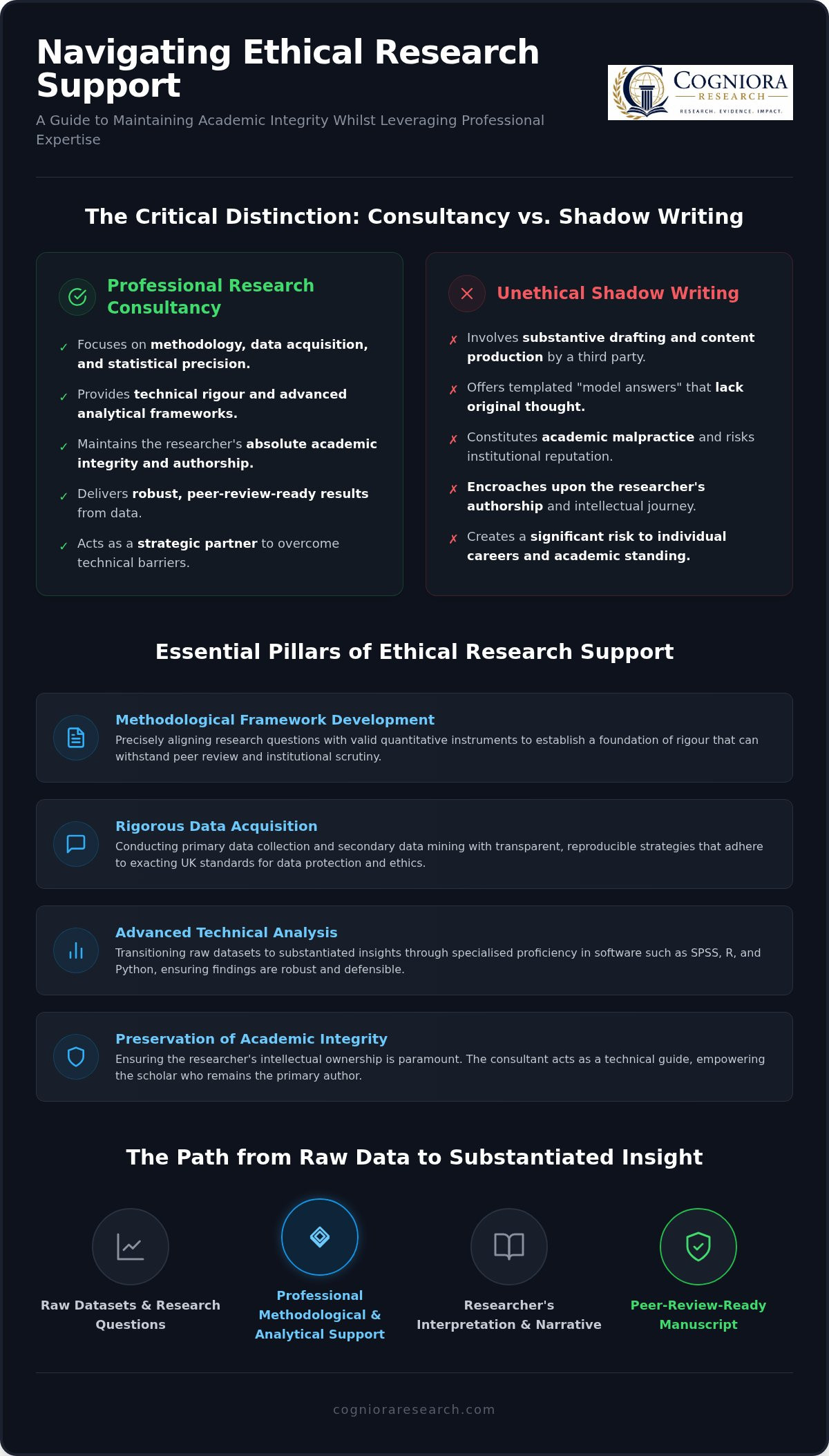
Distinguishing Professional Research Consultancy from Shadow Writing
High-level academic inquiry demands a rigorous synthesis of technical skill and original thought. Professional consultancy operates as a strategic partnership, providing the analytical tools necessary for success without encroaching upon the researcher's individual authorship. This distinction is paramount. Ethical support focuses on methodology, data acquisition, and statistical precision rather than the production of the final manuscript. By seeking research support without dissertation writing, scholars can ensure their work meets the highest technical standards whilst remaining entirely their own. It's a matter of professional gravity; the consultant provides the scaffolding, but the researcher builds the structure.
The Boundary of Academic Integrity
Maintaining the integrity of an original contribution to knowledge requires a clear demarcation between technical assistance and substantive drafting. Whilst proofreading addresses linguistic clarity, substantive drafting by a third party constitutes academic malpractice. Professional quantitative data analysis is a recognised standard in the UK, provided the researcher retains control over the interpretation and narrative. Engaging in a Research Ethics Consultation ensures that all external support aligns with institutional standards and ethical mandates. The researcher remains the primary author, responsible for the intellectual weight of the project, while the consultant acts as a technical guide. This collaborative model preserves the intellectual ownership that is the hallmark of scholarly achievement.
Consultancy vs. Content Mills
Professional research firms are defined by their methodological transparency, intellectual rigour, and scholarly authority. Unlike "content mills" that offer "model answers" or "shadow writing" services, a legitimate consultancy provides a bridge between raw data and informed action. These mills present a significant risk to institutional reputation and individual careers, often using templates that lack the depth required for genuine academic progress. Cogniora Research Limited maintains a strict stance on integrity; we provide the analytical frameworks and primary data collection services that empower researchers, but we never produce the dissertation or thesis itself. This methodical approach ensures that the resulting work is a true reflection of the researcher’s intellectual journey. True excellence is found in the rigorous application of methodology and the transformation of information into utility, which is why choosing professional research support without dissertation writing is the only ethical path for serious scholars. Our role is to act as a reliable, evidence-driven guide throughout the complex research environment.
Essential Pillars of Ethical Research Support
Ethical consultancy rests on four structural pillars: methodological design, rigorous data acquisition, technical analysis, and institutional modernisation. These components ensure that research remains a valid instrument for discovery rather than a mere academic hurdle. By engaging with research support without dissertation writing, scholars can isolate the technical complexities of their work from the intellectual authorship, ensuring that every claim is backed by robust evidence. It's a disciplined approach that values the integrity of the process as much as the final result.
Methodological Framework Development
Reliable research begins with the precise alignment of research questions with quantitative instruments. This process involves establishing clear parameters for validity and reliability, ensuring that the chosen study design can withstand peer review. Methodological rigour is the foundation of any defensible study. It requires a systematic approach to variable selection and hypothesis testing, preventing common pitfalls of biased or incomplete data structures. This foundation allows the researcher to move forward with composed confidence.
Navigating the complexities of primary data collection and secondary data mining requires more than just access to participants; it demands a deep understanding of UK standards for data protection and ethical clearance. Researchers must ensure their acquisition strategies are transparent and reproducible. Adhering to the University of Victoria's Ethical Editing Guidelines provides a useful benchmark for understanding how external technical support should interact with a student's or professional's own work. This ensures the researcher remains the sole architect of their narrative.
Institutional and Faculty Support
Educational institutions often face the challenge of modernising curricula whilst maintaining high faculty research output. Outsourcing technical analysis allows departments to focus on pedagogical delivery without compromising the quality of their empirical contributions. We provide Institutional Research Support UK: A Strategic Framework for Excellence, which helps universities navigate curriculum transformation and teaching framework modernisation. This strategic approach ensures that academic staff have the necessary tools to produce high-impact research whilst focusing on student outcomes.
Technical rigour is the final stage of this process, where raw variables are transformed into substantiated evidence through advanced statistical modelling. It's about moving beyond descriptive statistics to find the underlying patterns that drive real-world results. Scholars and institutions seeking research support without dissertation writing often find that technical bottlenecks, such as complex data mining or software proficiency, are the primary obstacles to publication. If your institution requires a strategic partner in methodological precision, focusing on these pillars is the most effective way to ensure long-term academic and commercial success. This methodical separation of tasks ensures the researcher remains the intellectual lead.
Quantitative Data Analysis and Technical Rigour
The transition from raw responses to evidence-based insights is a complex journey requiring both technical proficiency and intellectual discipline. It's not enough to simply collect data; one must apply advanced statistical modelling to extract meaningful patterns from complex datasets. Professional quantitative analysis involves rigorous cleaning and validation processes to ensure that every variable contributes to a valid conclusion. By focusing on research support without dissertation writing, we provide the technical rigour necessary for large-scale studies whilst leaving the final narrative in the hands of the primary investigator. This methodical approach ensures that the resulting evidence stands up to the most demanding institutional scrutiny.
Technical analysis is a standalone professional service that bridges the gap between raw information and informed action. It involves a systematic care that goes beyond basic software proficiency. Whether utilising SPSS, R, or Python, the goal remains the delivery of substantiated insights that can drive strategic decisions. Institutions requiring research support without dissertation writing benefit from this high degree of professional gravity, as it allows faculty and researchers to focus on their core intellectual contributions while we manage the analytical architecture.
Primary Data Collection Methodologies
Managing national-scale surveys and stakeholder engagement demands a high degree of organisational stability. Ethical considerations are paramount, particularly regarding participant data management and anonymity in accordance with UK standards. This empirical work acts as a bridge, transforming raw observations into strategic action. It requires a calm, expert voice to handle the complexities of data collection in a professional environment. By maintaining a serious and objective demeanor, we ensure that the primary data collection process is both transparent and reliable.
Secondary Data Mining and Synthesis
Leveraging existing knowledge bases through secondary data mining allows for the extraction of significant value from established datasets. Evidence synthesis plays a vital role in informing policy and strategy across the public and commercial sectors. Secondary data mining provides a cost-effective alternative to new field research. This logical and categorical approach to information architecture ensures that every insight produced is grounded in substantiated data. It allows researchers to identify longitudinal trends and market shifts without the resource-intensive requirements of fresh field work, transforming existing information into utility with methodical efficiency.
Evaluating an External Research Partner for Excellence
Selecting an external research partner requires a high degree of professional gravity and intellectual rigour. It's not merely about finding a service that promises a finished manuscript; it's about identifying a scholarly authority that can refine your methodological framework with precision. True excellence is found in firms that maintain a serious, objective demeanor and prioritise the delivery of substantiated insights over marketing flair. By opting for research support without dissertation writing, you ensure that your work remains your own whilst benefiting from the systematic care of technical experts. This partnership should act as a bridge between raw data and informed action, providing the technical scaffolding necessary for high-level inquiry.
Criteria for Professional Selection
The depth of analytical frameworks used by a consultant serves as a primary indicator of their expertise. You should verify their proficiency in advanced quantitative analysis and their understanding of pedagogical frameworks, particularly if the project involves curriculum transformation. Reporting must be evidence-based, objective, and grounded in intellectual rigour. For a deeper understanding of these standards, consult our Academic Research Support UK: A Strategic Guide to Methodological Rigour. A methodical, structured communication rhythm is equally essential. It ensures that every point is fully articulated before moving to the next stage of the journey. This deliberate pace reflects a disciplined approach to information architecture, where services and capabilities are clearly partitioned.
Navigating Institutional Requirements
External support must align seamlessly with university or government ethics boards to ensure the validity of the research. In the United Kingdom, public sector research often demands adherence to specific standards for programme evaluation and data transparency, such as those established for government social research. A professional partner acts as a reliable guide through these complex environments, managing participant data and primary collection with methodical efficiency. Transparency in the consultant-client relationship is non-negotiable. One of the most significant indicators of an ethical service is the explicit absence of "writing" from their offerings. This clarity ensures that the researcher maintains intellectual ownership whilst the consultant provides the technical bridge. If you require a specialised research partner to handle your quantitative data analysis, ensure they prioritise integrity and methodological precision above all else.
Cogniora Research: A Strategic Partner in Methodological Precision
Cogniora Research Limited operates with a high degree of professional gravity, positioning itself as a scholarly authority for those navigating complex analytical landscapes. We provide a bridge between raw information and informed institutional action, ensuring that every insight we deliver is substantiated by technical precision. Our expertise in primary data collection and quantitative analysis allows us to handle intricate research challenges with systematic care. By specialising in research support without dissertation writing, we offer a service that respects the intellectual boundaries of the individual researcher whilst providing the high-level expertise required for valid, peer-review-ready results. This composed confidence in managing complex variables ensures that our partners can focus on their core intellectual contributions without being stalled by technical bottlenecks.
Our Approach to Research Support
Our approach is defined by a methodical partitioning of services, which ensures clarity, thoroughness, and transparency throughout the consultancy process. We focus on the transformation of data into utility, acting as a reliable guide for both commercial and public sector initiatives. This disciplined approach to information architecture allows us to support curriculum transformation training for educational institutions, helping them navigate pedagogical change with evidence-driven confidence. We maintain absolute intellectual integrity, ensuring that our analytical frameworks stand up to the most rigorous institutional scrutiny. By acting as an expert voice in complex environments, we help institutions modernise their curricula without compromising academic standards. It's a process of growth, reliability, and transformation that turns raw information into actionable strategy.
Engaging with Cogniora Research Limited
When engaging with our team, researchers find a strategic partner committed to growth and methodological rigour. We support the research process through advanced statistical modelling and data mining without encroaching on the researcher's final authorship. This journey, from initial data collection to real-world results, is managed at a deliberate pace to ensure every point is fully articulated. Our work in public sector research adheres to current UK standards for programme evaluation, providing the reliability required for government-level reporting. We don't just provide numbers; we provide the methodological frameworks that allow those numbers to carry weight in a professional register. To discuss how we can assist your project, contact David Steel and the team to establish a strategic partnership built on scholarly authority and technical excellence. Choosing professional research support without dissertation writing is a mark of professional credibility that ensures your work remains defensible, distinct, and entirely your own.
Advancing Methodological Rigour and Scholarly Integrity
The pursuit of academic and professional excellence depends on the strict separation of technical expertise from intellectual authorship. By prioritising methodological precision and transparent data acquisition, you ensure your work meets the most demanding institutional standards. Accessing research support without dissertation writing allows you to leverage expert analytical tools whilst maintaining the original contribution to knowledge that defines your career. It's a disciplined approach. It protects your reputation.
Cogniora Research Limited acts as a strategic partner, offering national UK coverage for public and commercial sectors. Our team provides specialists in quantitative data analysis and experts in curriculum transformation training to help you bridge the gap between raw data and informed action. We handle the technical architecture. You focus on the intellectual narrative. Every insight is substantiated through advanced statistical modelling and systematic care. It's a journey of growth and substantiated insight that elevates your research to its full potential.
Explore our ethical research and data analysis services today to secure the technical precision your project deserves. We're here to guide you toward results that are both robust and defensible.
Frequently Asked Questions
Is research support without dissertation writing legal and ethical in the UK?
Professional research support without dissertation writing is entirely legal and ethical within the UK, provided the consultant's role is restricted to technical and methodological guidance. Ethical consultancy prioritises the researcher's intellectual ownership, focusing on data analysis and framework development rather than drafting the final manuscript. This distinction ensures compliance with university academic integrity policies, which prohibit ghostwriting but often encourage the use of specialist statistical services to enhance the rigour of empirical findings.
What specific services are included in professional academic research support?
Professional support encompasses a range of technical services designed to strengthen the empirical foundations of a study. These include quantitative data analysis using software like SPSS or R, primary data collection via national-scale surveys, and secondary data mining. Consultants also provide methodological design guidance to ensure study validity. Importantly, these services exclude any form of substantive drafting, ensuring the researcher remains the sole author of their work whilst benefiting from expert technical scaffolding.
How does quantitative data analysis differ from dissertation writing services?
Quantitative data analysis is a technical service focused on the mathematical processing of raw data into substantiated insights. It involves statistical modelling, data cleaning, and validation to identify patterns and trends. In contrast, dissertation writing services involve the unethical creation of the narrative text itself. By focusing on analysis, a consultant acts as a technical partner who provides the evidence, leaving the interpretation and authorship entirely to the researcher, thereby maintaining absolute academic integrity.
Can an external firm help with primary data collection for my study?
Yes, professional firms frequently manage primary data collection, particularly for large-scale surveys or stakeholder engagement projects that require national UK coverage. This support involves designing robust collection instruments, managing participant recruitment, and ensuring data protection standards are met. By outsourcing the logistical complexities of data acquisition, researchers can ensure a higher response rate and more reliable datasets, allowing them to focus their intellectual efforts on the subsequent analysis and discussion of the results.
Will using a research support service affect the originality of my work?
Utilising technical research support does not compromise the originality of your work, as the intellectual contribution to knowledge remains your own. Originality is defined by the unique research questions, the conceptual framework, and the final interpretation of findings. Technical assistance with data mining or statistical modelling is a recognised standard in high-level research, acting as a tool that empowers the author to produce more rigorous evidence without replacing their original scholarly voice or creative thought.
How do institutions benefit from curriculum transformation training?
Institutions benefit from curriculum transformation training by modernising their teaching frameworks to meet current pedagogical standards. This training assists departments in implementing effective changes that align with modern research requirements and industry needs. By updating curricula, universities can enhance student outcomes and ensure their academic staff are equipped with the latest methodological tools. This strategic approach fosters an environment of continuous improvement, allowing institutions to remain competitive and relevant in an evolving global educational landscape.
What is the role of secondary data mining in commercial research?
Secondary data mining plays a vital role in commercial research by extracting significant value from existing datasets to inform market strategy. This process allows businesses to identify longitudinal trends and consumer behaviours without the resource-intensive requirements of fresh field research. It provides a cost-effective alternative for organisations seeking to ground their strategic decisions in substantiated evidence. By synthesising existing information into actionable utility, firms can gain a competitive advantage and drive informed institutional action with methodical efficiency.
How can I ensure my research support meets public sector standards?
To ensure research support meets public sector standards, you should verify that the consultant adheres to UK-specific guidelines for programme evaluation and data transparency. Professional firms like Cogniora Research Limited align their methodologies with government social research standards, ensuring that data collection and analysis are both robust and defensible. This includes maintaining high levels of participant anonymity and data security. Choosing a partner with a serious, evidence-driven approach ensures that your research findings can withstand the most stringent public sector scrutiny.


